Organisational Alignment System
Connect and align every role with the strategic plan.
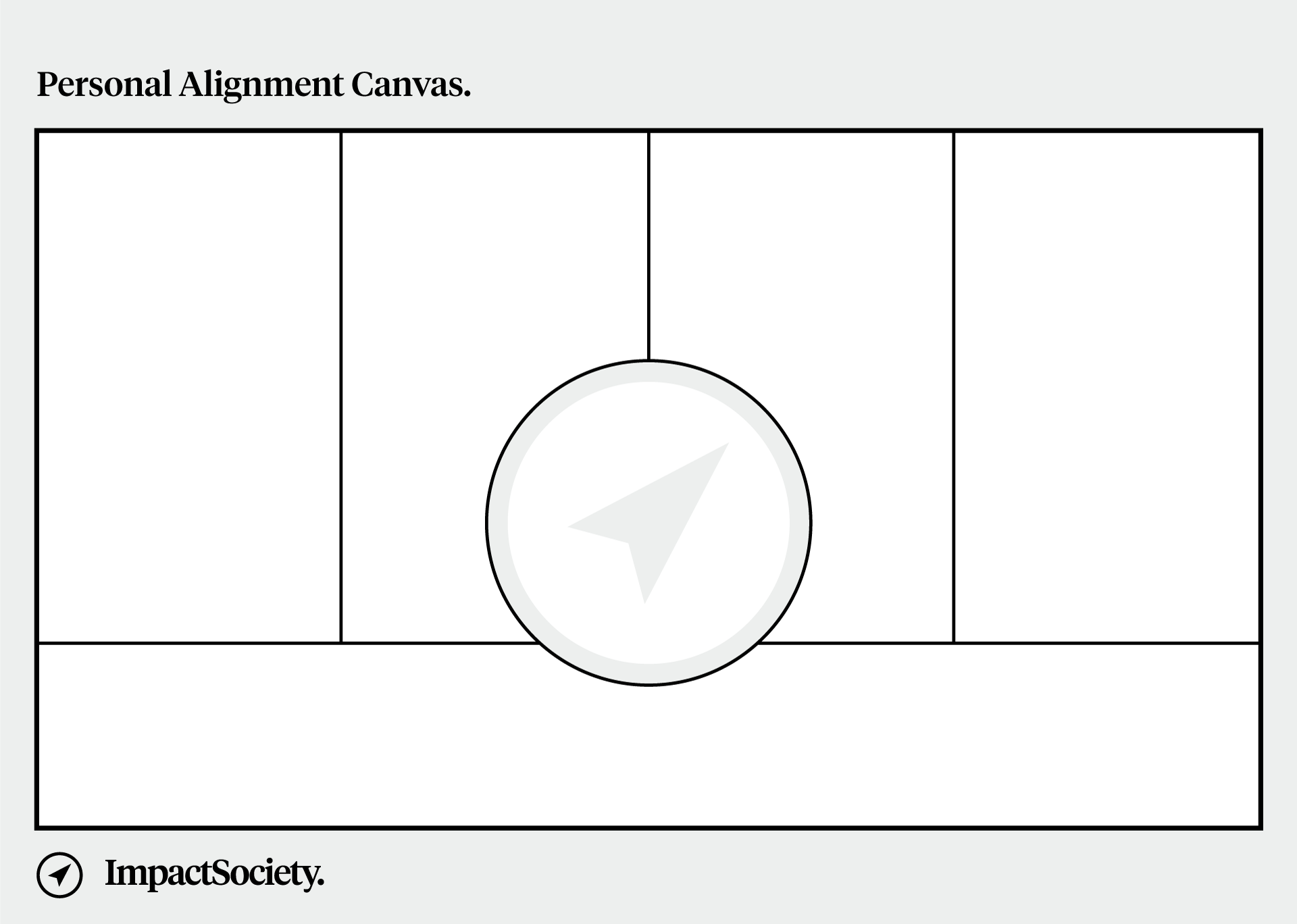
The Personal Alignment Canvas is a one-page tool for connecting each role in your team to the organisation’s strategy – so every person knows why their work matters.
Our alignment canvasses are used around the world.


The Personal Alignment Canvas is a free one-page tool that answers six questions about a single role. It is the individual companion to the Team Alignment Canvas – the last step in a cascade that runs from the organisation, to its groups and teams, to every person you lead. One page, six questions and a clear line of sight from what someone does day-to-day to where the organisation is going.
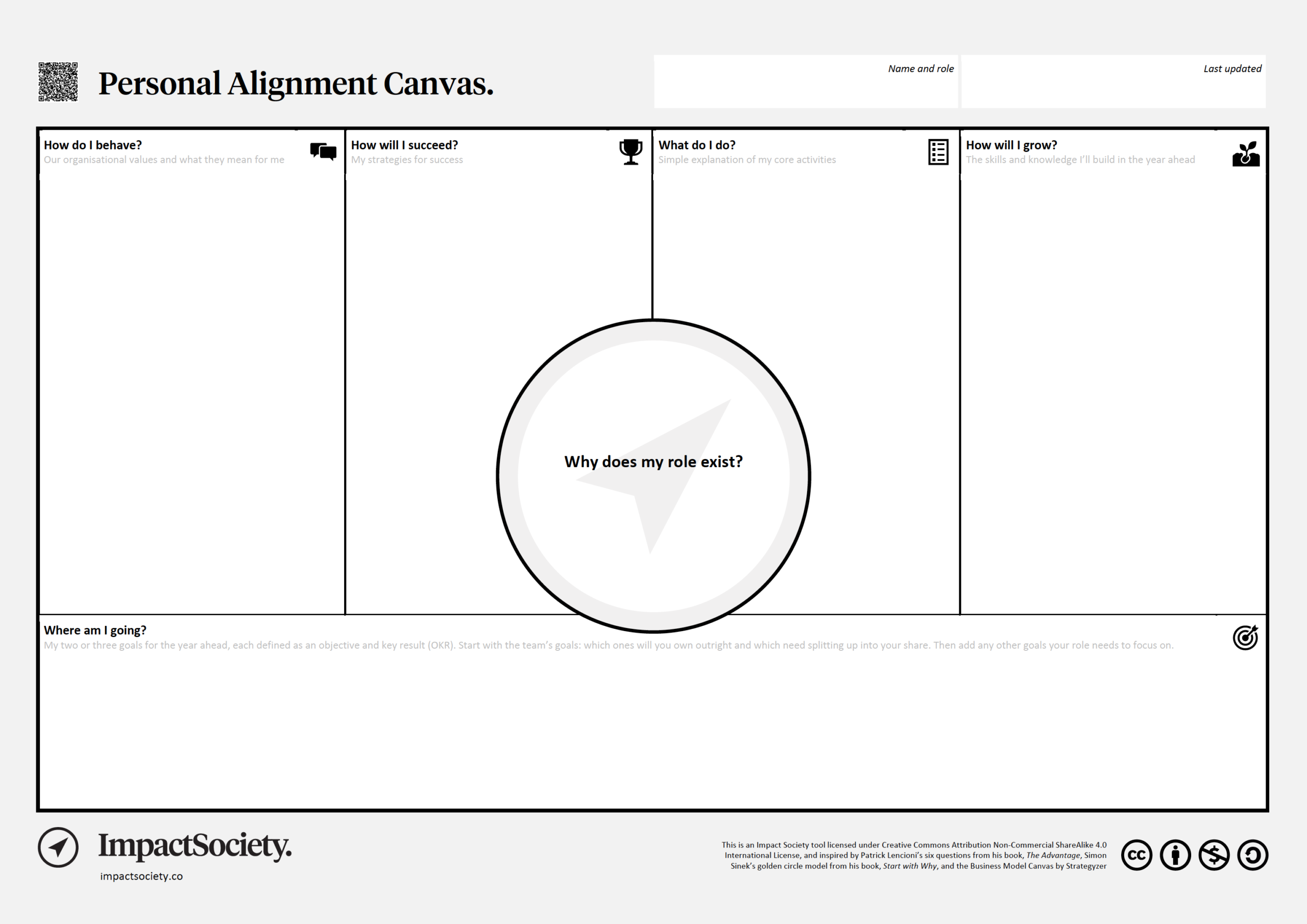
The Personal Alignment Canvas makes it easy to…
- Show every person exactly how their work connects to the organisation’s strategy
- Agree the purpose of each role with the person doing it, in writing, on one page
- Turn the organisation’s values into behaviours you can coach
- Split the team’s goals so everyone knows which part is theirs
- Plan what each person will learn this year, and how
- Run one-to-ones and reviews from a starting point you both already agreed
The Organisational Alignment System
One system. Three levels. Every role connected.
A simple set of six questions get asked at every level of an organisation. The Team Alignment Canvas answers them for the organisation as a whole, and then again for each of the groups and teams within it. The Personal Alignment Canvas answers them for each individual role.
Which means nobody starts from a blank page. Every box on a person’s canvas has a parent somewhere on your team’s canvas, so their answers are anchored to yours before they start. You give them the starting points and they take it from there.
This is what creates connection and alignment across an entire organisation: it aligns and engages. Which gets everbody pushing harder, in the same direction.
Level 1
The organisation.
The organisation answers the six questions for itself – its purpose, its values, how it will succeed, what it does, who does what and where it’s going over the next 5 to 10 years.
Team Alignment Canvas • Strategic Planning Toolkit • One Day Planning Workshop
Level 2
Groups and teams.
Each group and team then answers the same six questions for itself, working from the level above. Its ‘Who does what?’ box names every role in the team and each of those entries becomes the starting point for the level below.
Team Alignment Canvas • Team Planning Toolkit • One Day Planning Workshop
Level 3
Every person.
Everyone who doesn’t lead a team of their own answers the six questions for their role. Their purpose starts life as their entry in your ‘Who does what?’ box, and ends up as a statement of why the role exists and who’s better off for it. Anyone who does lead a team gets a Team Alignment Canvas instead.
Personal Alignment Canvas
Start with why, not with what.
Most job descriptions fixate on what tasks a role must get done. They come with a long list of duties, corporate jargon on levels and reporting lines, and padded out across several pages by an impractical template that someone in HR created a long time ago. They’re usually updated when recruiting someone before being quickly forgotten about. But, as Simon Sinek argues in his book Start with Why, purpose engages people in a way that lists of tasks never do. That’s why the Personal Alignment Canvas puts the why first and lets everything else follow from it.
Old management
A typical job description.
- Leads with a list of duties
- Fixes what the role does at a single point in time
- Becomes a fence to hide behind – “that’s not in my job description”
- Written to recruit, then filed and rarely opened again
- Needs a separate development plan, separate goals and a separate values statement alongside it
- Runs to several pages, most of it boilerplate
New Management
The Personal Alignment Canvas.
- Leads with why the role exists and who is better off for it
- Expects the what to change, because the why is what matters over time
- Sets activities as a means to the purpose, not a boundary around it
- Written by the person, agreed with you and used all year
- Folds development into ‘How will I grow?’ – no separate plan to maintain
- One page

Set it once. Recentre every fortnight.
Getting everyone aligned is just the start. Because keeping them there can be hard. Roles change, priorities move and six months later the canvas is describing a job nobody is actually doing any more. The way to stop that happening is to spend five minutes on it at the start of every one-on-one.
Check what’s changed.
Ask what’s happened since you last met that the canvas doesn’t cover. It’s far easier – and more powerful – to update a line or two as you go than to rewrite the whole thing every six months.
See if the what needs updating.
Day-to-day activities are usually the first thing to drift, often without anyone realising. Check that what they’re doing still delivers on why the role exists. If it doesn’t, it’s usually the activities that need to change – not the purpose.
Review actual vs plan.
Run through where they’re up to on their goals and on what they said they’d learn this year. Growth is the first thing people drop when work gets busy, so asking about it regularly helps keep them on track.
If your one-on-ones aren’t up to scratch, our free Guide to Great One-On-Ones is a good place to start. It covers how often to hold them, what they’re for and how to run them – and it comes with agendas, e-mails and calendar invites you can use as they are.
See the Personal Alignment Canvas in action.
We’ve completed a sample canvas for three different roles, across three different sectors. Each one answers the same six questions on the same single page.

Health and Safety Advisor.
Infrastructure, major projects
A specialist role with no direct reports, advising project teams and contractors. The interesting part is the purpose: it isn’t to own safety on site, it’s to build the project leaders’ ability to own it themselves – which changes what the rest of the canvas says underneath.
Coming soon!

Registered Nurse.
Public hospital, ward based
Most of what this role does day to day is already set by protocol and roster, so people assume there’s nothing left to align. The canvas shows there’s plenty: why the role exists, what the organisation’s values ask on a long shift and what they want to learn this year
Coming soon!

Policy Officer.
State government, housing
Policy work can take two years to show any result, so ‘who’s better off because this role exists?’ can be a hard question to answer. It’s worth the effort though – without it, the canvas just becomes a list of documents produced.
Coming soon!
Coming soon
The Personal Planning Toolkit.
You could personally develop a canvas for each member of your team, but it would cost you a lot of time – and do nothing to engage your people.
The Personal Planning Toolkit works the other way round. You issue it to each person, and the guidebook takes them through the six questions themselves – the why, how and what of their role, what the organisation’s values mean to them, what they’ll prioritise this year and how they want to grow. There’s a short intro describing the manager’s role, but otherwise the guidebook is written for the team member, not the manager.
That’s more work for them and less for you, by design. People must weigh in before they can buy in: a document someone has steered themselves is one they’ll stick to when things get busy – and one you can hold them to.
1
Issue it
Send the toolkit to each person who doesn’t lead a team of their own, along with your Team Alignment Canvas – ideally one they helped develop. It gives them their starting points: their entry in ‘Who does what?’, the organisational values and their share of the team goals.
2
They do the work
Start with a kick-off meeting to talk through where they might look – and think – for their answers. The guidebook then walks them through all six questions, with advice and worked examples for each. They draft their canvas and bring it back to you.
3
Agree it together
Go through the draft together. Test their thinking and offer guidance on where it needs to line up more tightly with the team’s direction. Once you’re both happy, sign it off and put it into your one-on-ones for a regular check-in.
Inside the toolkit
- Step-by-step guidebook written for the person in the role
- Prompts and worked examples for all six questions
- A manager’s brief: what to supply, what to look for, when to sign off
- Editable Personal Alignment Canvas templates
- Completed examples across specialist, delivery and knowledge roles
- E-mail and calendar invite templates for issuing it and booking the sign-off
- Checklists for both sides
- Instant digital download, with a 30-day money-back guarantee
Join the wait list.
Enter your e-mail address and we’ll let you know as soon as the Personal Planning Toolkit is ready to go.
By proceeding, you also agree to join our newsletter and to our terms of service. You can unsubscribe any time.
Toolkits for the levels above.
The Personal Alignment Canvas works on its own – but it works better when the canvases above it are already done. If you are starting from scratch, these are the toolkits that build the levels above your people.
Strategic Planning Toolkit.
Align your leadership team around a clear, shared direction. A proven process to define your purpose, prioritise what matters and build a one-page plan your whole organisation can get behind.
Team Planning Toolkit.

Help individual teams connect to the bigger picture. Designed for team leaders to translate organisational strategy into clear team-level plans with shared goals, team dynamics and a roadmap for contribution.